The independent proof layer for AI agent work.
The platforms secure how agents run: sandboxes, runtimes, permissions. What stays open is the decision: may this piece of agent work go live, and who can prove it was checked? We run that layer, because the examiner cannot belong to the examined.
A system map, gated changes, a readable proof record, and a human sign-off. Plus what we are not, and the gate you can run yourself.
Agents are joining the org chart. Sign-off has not.
Organizations are giving AI agents real work: code, content, configuration, operations. The output now arrives at machine speed, and it looks plausible at a glance. The question boards and auditors ask has not changed: who checked this, and who signed off before it went live?
Agent platforms have made real progress on securing how agents run: isolated environments, permissioned tools, managed runtimes. That layer exists, and it is not the gap.
Whether a specific piece of agent work may reach production is a judgment about one change in one system. Someone has to check it, record the check, and take responsibility for the release.
A proof layer inside the platform that produced the work grades its own homework. Credible proof has to be independent of the model, the vendor and the runtime that did the work.
First, a map of what exists.
A controlled zone is only as good as the map it is drawn on. Before the four working parts below begin, we chart the system they will govern.
The system, mapped before the boundary is drawn
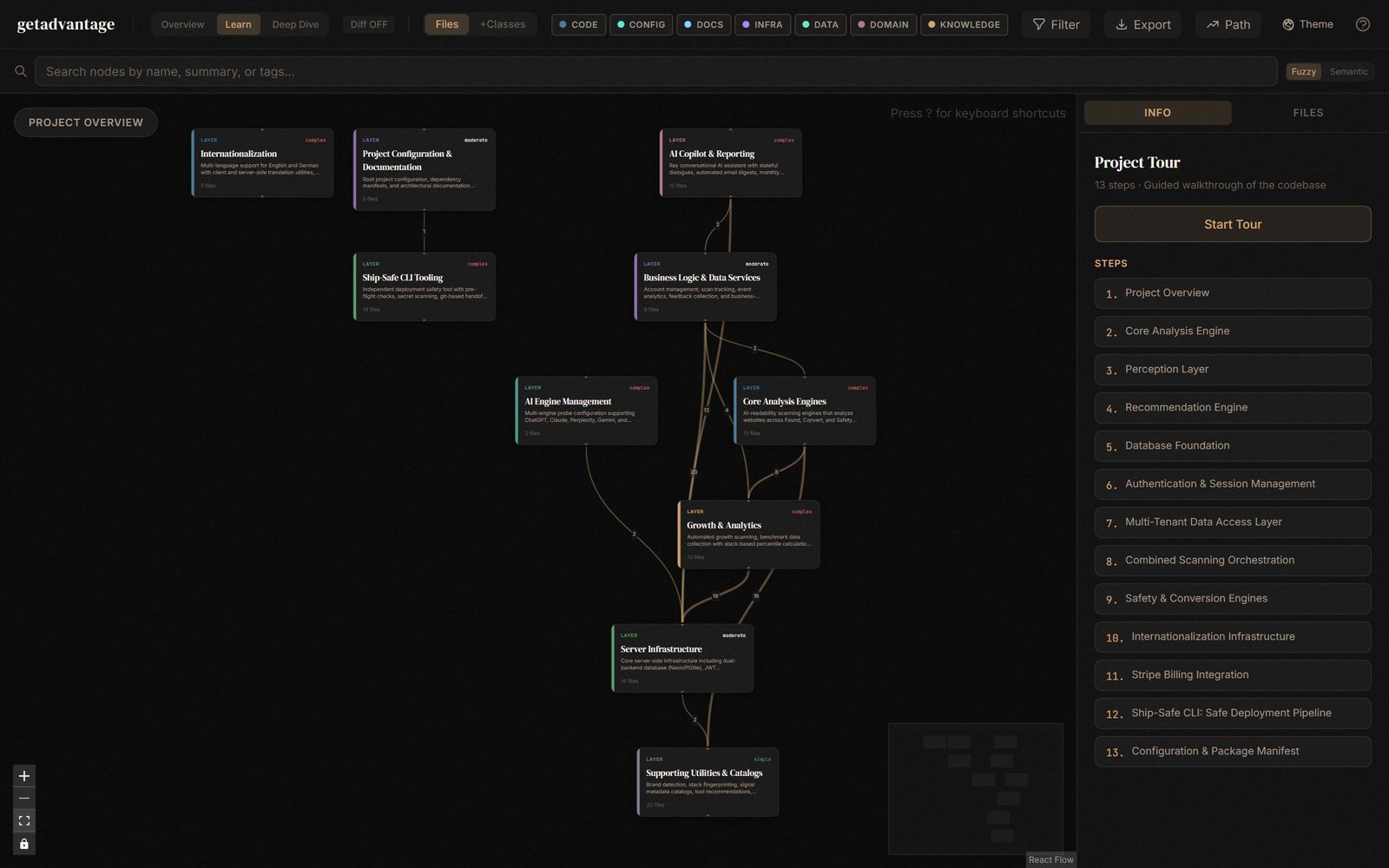
Before the zone is drawn, we map what exists. We turn the codebase into an interactive knowledge graph: every layer, file, function and dependency, plus a guided tour a new engineer or an auditor can follow. The mapping runs inside your perimeter, and the model endpoint is pinned to yours: your cloud, or a sovereign gateway. We audited the pipeline ourselves: no telemetry, nothing persisted outside the project. Openly built on open source, operated under our governance.
The proof layer, in four working parts.
Nothing below is a roadmap item. These are the working parts of every engagement, and they map directly onto what governance teams ask for: alignment, reliability, measurable outcomes, auditability.
What the agent may touch, written down first
Before an agent touches anything, we draw the boundary: the files, routes and services in scope, and what stays off limits by default. The zone lives in the repository itself, so every model and every session reads the same boundary before it works. Agent work aligns with your governance because the boundary is written down where the work happens, not in a policy document nobody loads.
Every change clears the same fixed checks
Before anything reaches production, the change runs through a fixed sequence of 7 checks. Each one catches a specific failure that AI-written work ships often, and a single blocking check turns the whole run into a NO-GO. The checks are identical on every run, which is what makes the outcome reliable rather than lucky. Each gate has a public explainer:
Every decision leaves a record you can read
Every run ends on a record of what was checked and what the checks found: each check with a pass, a warning or a fail, then one overall verdict. Every line is a measurable outcome, an observed measurement at run time, never a feeling. A recorded run can be shared as a read-only report page, so the proof travels to an auditor or a board without granting access to anything else. The record never claims more than the checks actually saw.
The machine measures. A human releases.
The gate produces a verdict. It does not press the button. A NO-GO stops the ship until the blocking issue is clear, a GO with warnings hands a person the warnings to eyeball first, and even a clean GO ends with a person walking the live result before the work is called done. Each piece of work ends on a plain go or no-go, in writing.
The full method, from the controlled zone to the proof record, is on the methodology page.
Forward-deployed, founder-led.
We do not hand you a login and wish you luck. The founders set up the controlled zone and the gates inside your existing repository and pipeline, run the first pieces of work through them with your team, and stay until your people can drive it. When the engagement ends, the gate stays: it lives in your infrastructure, not ours. Every engagement starts with a conversation, not a checkout.
What we are not.
Choosing infrastructure for agents means knowing exactly what each vendor is. Here is what we are not, stated plainly.
Not a hosting platform
We do not run your agents and we do not sell compute. No sandboxes, no VPC deployment, no managed runtime. If you need a place for agents to execute, that is an agent platform, and you should buy it from a vendor who does exactly that.
Not a certified cloud provider
We are not a SOC 2 certified cloud service, because the gate is not a cloud service. It is open source and runs locally, inside your own infrastructure and your own pipeline. Nothing leaves your machine unless you opt in to reporting.
The honest split
If you are deciding where agent work should run, you need a different vendor. If you need proof that agent work was checked, and a sign-off before it goes live, that is exactly what we do.
The same gate, in the open.
The pre-deploy gate we run in engagements is a public npm package you can read line by line. Run it in any repository, or hand it to your agents over MCP:
The full command surface, an honest example run, and the source links are on the ship-safe page.
Bringing agents into the organization? Start with the proof layer.
Thirty minutes over video, directly with the founders. No obligation.